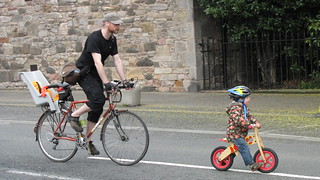
Thanks for the video @arellcat
The BGS (online and the records at Kings Buildings has the core logs for a substantial series of surveys the length of Princes Street which also confirm the stupidity of the way the current on street tram tracks were built and continue to provide a significant cost & liabilties for pavement condition and maintenance
When the tram tracks were built the entire carriageway was stripped out from Haymarket to Waverley bridge with the undelying ground (subgrade) recorded by the core logs as alluvial (glacial) clays & sands lying over fractured shale, which was generally saturated, as a raised beach alongside the Nor Loch that filled the valley beside the volcanic plug that deliverd the plug & tail formation of Edinburgh Castle and the Royal Mile down towards Holyrood Palace
The removal of the 200 year old pavement destroyed the compaction & stability of the carriageway for the whole distance and this is clearly visible with every load transfer joint cast between each section of the upper track slab fracturing with lumps of concrete falling out & patch repairs, plus the steel frames of chamber, and valve covers for the whole distance needing continual repairs including the use of steel road plates, some in place for over a year, plus a section of Princes Street - the Westbound lane near South St David Street sinking by around 6 inches
My work in 1999 to revise the 1870 Tramways Act was a vital detail urgently required to deal with the problems of Manchester, Sheffield and Croydon tram systems as the rails collapsed into the carriageway pavements. From this and work with the Joint Venture contractor building the extension in Manchester we delivered some key changes - which were NOT adopted for the first stage of Edinburgh Tram construction, and resulted in the urgent need to strip out & reinstall the on street track along Princes Street, and still get it wrong!
The Manchester teams were like the Network Rail Scotland team building each stage of the EGIP project to improve on estimated costs and delivery schedules, as each small extension had the practice from the preceding work
In Manchester before any track slab was cast, the ground strength and stability were checked with remedial work delivered before the final track was laid - for the engineers this used the day work allowances for work after testing tor California Bearing Ratio (load bearing) and vane tests (soil cohesion). Indications suggest that ground conditions were not remediated sufficiently after the compacted upper layer was stripped away - I had this problem in Glasgow when we built a ramp down through the old railway embankment, built up with silt dredged from the River Clyde & Docks and capped with a 'skin of furnace slag and slack coal...stables as long as you didn't dig a hole through it!
However we do have a way to dig a tunnel all the way from North Bridge/Waterloo Place to Haymarket Terrace/Haymarket Yards, whilst keeping the roads open with a system proven in 1963 , when the new station was built at Oxford Circus underneath a steel umbrella which was built in a Bank Holiday Weekend. Back in 1974 the firm I worked for made long-wall mining kit with roof supports which could be the system to build the Princes Street Tunnel, that can include an all-weather shopping street and a collonade for crowds to have shelter when the Castle and gardens feature in the spectacular Son et Lumiere events which Edinburgh has a reputation for
Paying for this .... well lets apply the economic model from Henry George which delivered the railways between 1722 and 1923, and whole new towns like New Lanark with private money
Heres the 'Umbrella film'
https://www.ianvisits.co.uk/articles/50-years-ago-a-huge-steel-umbrella-for-oxford-circus-tube-station-8955/
This project can use the same steel umbrella for a second stage digging a cavern UNDER George Street to relocate the current St Andrew Square Bus Station, as buses & coaches are increasingly 100% electric so that an underground bus station doesn't have the diesel fumes to deal with
Itws drastic & radical, just 6the sort of work that Scottish engineers like Arrol, Baker, McAlpine deliverd in their day, which still stand & remain in use
Do DM for developing this - |I'm seriously under resourced to deliver material & welcome opportunities to reprise the mentoring I used to do with undergraduate engineers & Scottish Universities....
Might even hire @arellcat for her helpful research & a few other CCE co conspiritors!

 posts
posts